We have got Limited Seats and they are filling up fast! Book Free Assessment
Now
!

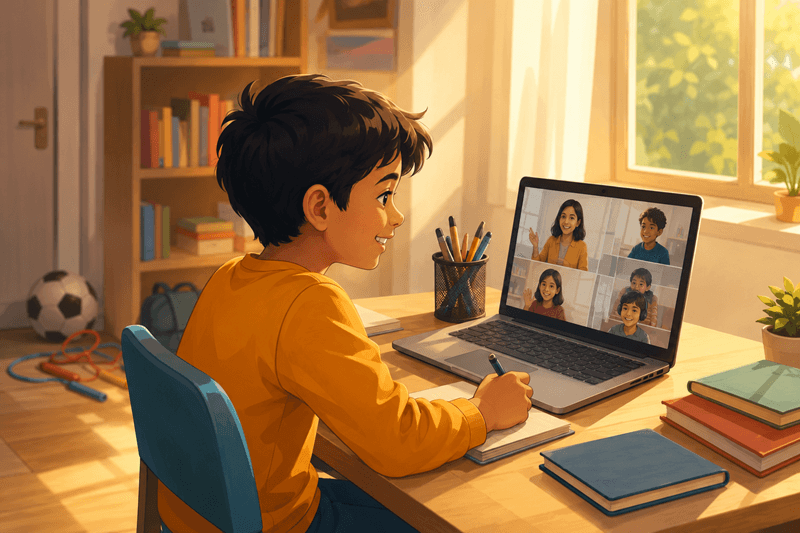
For a lot of parents, the hesitation isn’t about curriculum. It’s not about whether TWF’s teaching is good, or whether the results are real. It’s simpler than that. It’s the question that sits underneath everything else: if my child isn’t sitting in a classroom with other children, are they missing something they can’t get back?
That question comes up often enough in our conversations with parents that it deserves an honest answer, not reassurance dressed up as one.
This is the concern that comes up most, and it’s a fair one. If a child isn’t sitting in a room with other kids every day, are they actually learning to work with people, or just learning alone in front of a screen?
Here’s a small, unscripted example from our own cohort. A group of TWF students were working together on a class project, coordinating over chat, when they realized a classmate hadn’t been added to the conversation. Nobody assigned this as a task. The students simply noticed, found her contact themselves, and brought her in. What followed, by one parent’s account, was half an hour of disagreement over small things, fonts, icons, whose idea came first, before the group settled into actually listening to each other and building something together.
That’s not a tidy, engineered moment. It’s what real collaboration looks like when it’s happening for the first time in a new setting, and it happened on its own, inside our own classroom, without anyone engineering it to make a point. It’s the same kind of unscripted curiosity we’ve seen show up in how our students approach open-ended problems more broadly, not just in group projects.
Handwriting is a concern parents raise, and it’s a fair one. A screen-based learning environment doesn’t naturally build the same handwriting practice a paper-and-pencil classroom does, and that’s a genuine tradeoff of online learning, not something we’re going to pretend away.
Right now, the instructor’s primary focus for younger learners is speaking and listening, building the confidence to express themselves out loud before anything else. Grammar lessons follow that, with writing coming after. Handwriting itself isn’t ignored: it’s incorporated occasionally within that sequence, rather than being the starting point. It’s a deliberate order, built around how children actually build confidence and skill, not an absence. That same sequencing logic runs through how our broader learning model is structured, skills build in a specific order for a reason.
School is not the whole of childhood, and TWF doesn’t try to make it one. Classes run from 9:15 to 3:15, Monday through Thursday, and within that window, the day is built around an inquiry-driven project stream: real questioning, investigation, and problem-solving, not passive screen time. Friday is a lighter day, and part of it is set aside as a Game Day, with breakout sessions where kids play their favorite games together and just socialize, from the comfort of their own homes. But the day doesn’t end there, and what happens after matters just as much. We encourage every family to use that time deliberately: karate, swimming, exploring their actual surroundings, whatever the child actually enjoys, or simply time outdoors at a park. Kids who’ve been thinking hard all day still need to move, explore, and be kids in the ordinary sense once school is done. It’s part of why we’ve also moved away from rigid, anxiety-driven assessments toward something that keeps a child’s energy and curiosity intact rather than draining it.
Yes, there are real tradeoffs to online learning. No, we’re not pretending otherwise. But some of what parents fear most, like whether their child will really learn to work with others, isn’t left to chance here. It’s built into how the program runs. And the academic depth TWF gives back for the trade is real.