We have got Limited Seats and they are filling up fast! Book Free Assessment
Now
!
Giants brought to their knees. CEOs of billion-dollar companies unable to hold back tears. Why does that happen? Why would people who seemingly did everything right still lose?
One word: adaptation.
The world does not wait for systems, industries, or people to feel ready before it evolves. And perhaps nowhere is that shift more visible today than in education itself.
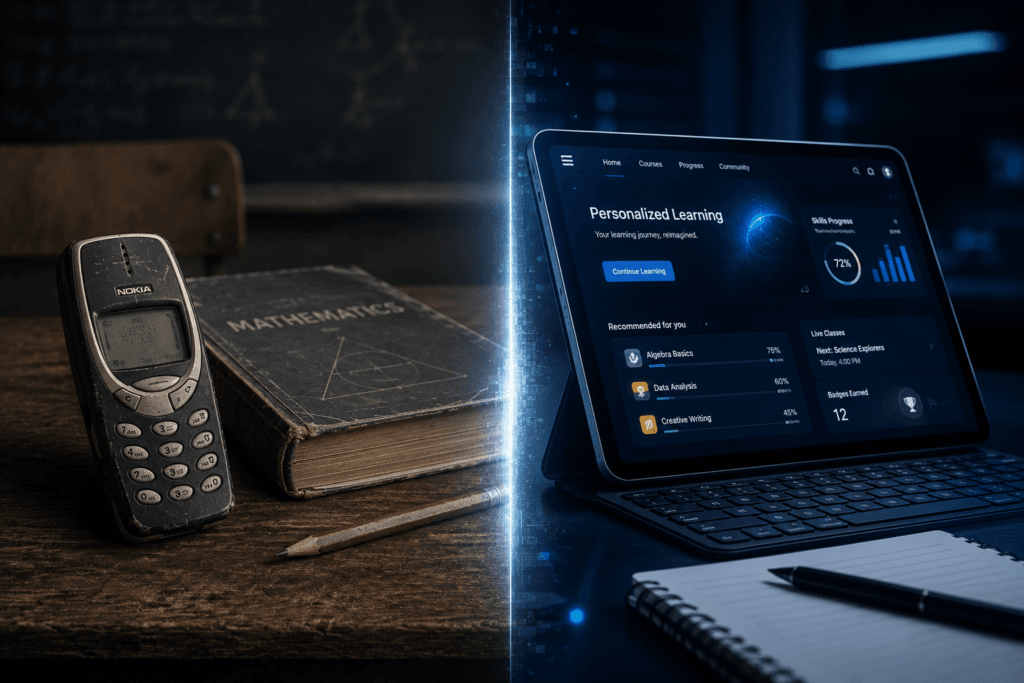
A story often told about Nokia’s decline captures the idea perfectly. A company that had done everything right, built a trusted product, served its customers well, and still lost. Not because of poor decisions, but because the world moved and the system did not move with it. The phrase most associated with that moment is something like: we did not do anything wrong, but somehow we lost.
Nokia was once untouchable. It was safe, familiar, and trusted by everyone. People believed it would always remain relevant because it had worked for so long. But the world changed faster than the system did. Touchscreens evolved. Software evolved. User behaviour evolved. And eventually, safe was no longer the point.
As I sat with that thought, I could not help but think about education in Pakistan. And about the conversations so many parents are having today.
Traditional schooling feels safe because it is familiar. It is what most of us grew up with. Fixed classrooms, uniform pacing, repetitive worksheets, memorisation-driven learning, and examinations that prioritise retention over genuine understanding. Because generations before us experienced this same structure, we have come to associate it with stability, credibility, and success, often without questioning whether it still aligns with the demands of the world our children are growing into.
The future of education in Pakistan, like everywhere else, is being shaped by forces that fixed classrooms and annual examinations were never designed to handle. The world our children are entering looks nothing like the world we grew up in. Artificial intelligence can already retrieve information faster than any human being. Entire industries are changing in real time. Careers that exist today may disappear tomorrow, while future professions have not even been created yet. In a world like this, the value of education can no longer lie only in memorising information. The real value now lies in adaptability, critical thinking, communication, creativity, problem-solving, and the ability to learn continuously.
“Choosing what is familiar is not the same as choosing what is right for the future.”
When comparing online school vs traditional school in Pakistan, the conversation often starts in the wrong place. Parents ask: is online school as good as a real school? But that framing already contains the assumption that traditional school is the standard everything else should be measured against.
A more honest question is: which model is actually preparing my child for the world they are going to live in?
I have heard parents say things like: but will they be able to blend back into the traditional system afterwards? And honestly, that question itself reveals something important about how deeply conditioned we have become. Why is our biggest concern whether a child can fit back into an old system, rather than whether that system is preparing children for the future? Why are we more worried about conformity than capability?
There is a pattern throughout human history worth paying attention to. Gyms once seemed irrational. Why pay to exercise indoors when daily life already provided movement? Then society became sedentary. What seemed unnecessary became essential. Online shopping once felt unreliable and impersonal. Then time became scarce, traffic worsened, and COVID-19 closed markets overnight. What was once suspicious became integrated into everyday life.
Education is standing at a very similar moment. The criticism of online education is not entirely unfounded. Children absolutely need movement, emotional connection, social interaction, and real-world engagement. Poorly designed online environments can become passive and isolating. These concerns deserve serious attention.
But educational progress has never depended on abandoning every system with limitations. It has depended on identifying weaknesses and improving them thoughtfully rather than rejecting the possibility entirely. Traditional schooling itself contains limitations that have remained normalised for decades simply because they are familiar: rigid pacing, overcrowded classrooms, standardised instruction, excessive memorisation, and limited space for individual learning differences.
At TWF, we believe education must evolve alongside the world children are growing into. Not by removing structure, but by redesigning it with intention. The first year of the program is built around deeply understanding each learner: their pace, their interests, their strengths, their cognitive patterns, and their learning behaviour. Because before preparing children for advanced application, we first need to understand how they actually think.
The second year moves into AI and education in the most practical sense: using AI tools, understanding how they work, and developing the judgment to use them well. This sits alongside interdisciplinary project development, critical thinking, innovation, research, and practical application rooted in strong foundational understanding. Mathematics becomes more than equations. It becomes algorithmic thinking. Writing becomes more than grammar. It becomes communication and persuasion. Research becomes more than collecting information. It becomes learning how to think independently.
Children are naturally curious, adaptive, creative, and capable of extraordinary thinking when given the right environment. The question is whether the educational environment around them is designed to develop those qualities or to suppress them in favour of compliance and coverage.
When parents in Pakistan today are weighing online school vs traditional school, or considering alternative education altogether, they are not simply choosing a delivery method for education. They are making a decision about what kind of thinker, communicator, and problem-solver their child will become.
The hardest part for many parents is not the curriculum itself. It is the leap of faith. The willingness to step slightly outside what feels familiar and ask: what if there is a better way to prepare my child for the future?
That hesitation is completely understandable. Change is uncomfortable. Every major shift in history has initially felt risky. But history also repeatedly shows us that the systems which survive are rarely the ones that resisted change the longest. They are the ones willing to evolve before they were forced to.
The Nokia story did not end because of bad decisions. It ended because the world moved and the system did not move with it. The question for every parent thinking about their child’s education is a simple one: are you choosing what has always worked, or are you choosing what will work for the world your child is actually going to live in?