We have got Limited Seats and they are filling up fast! Book Free Assessment
Now
!

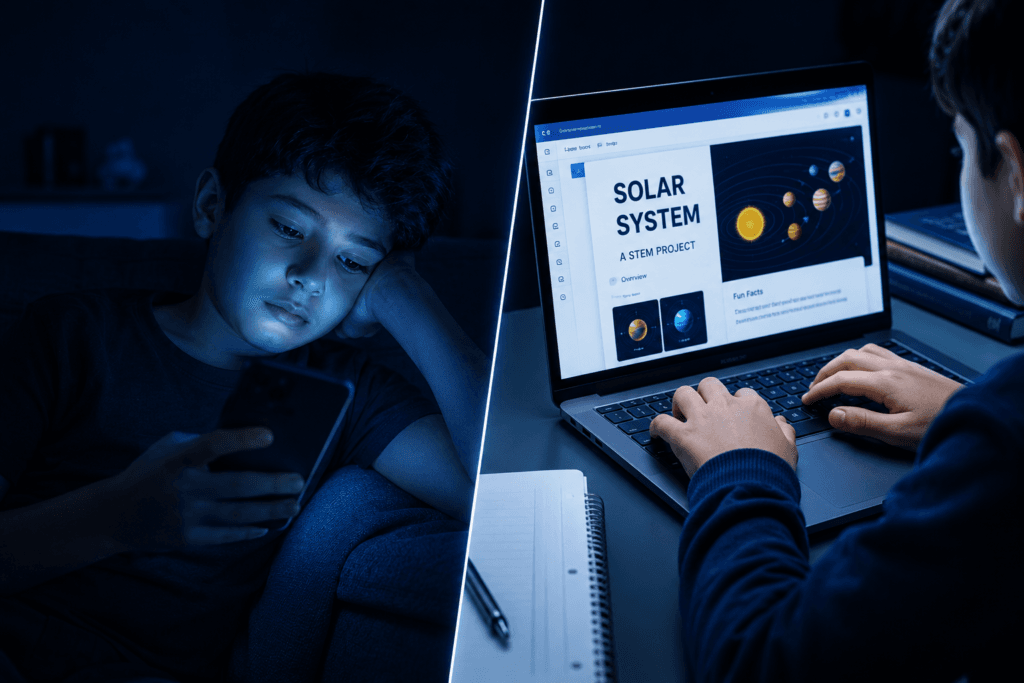
In today’s time, a car without a driver is considered fascinating. Yet a school without a building still induces fear. In an era of remarkable technological progress, education remains tied to one idea: a physical classroom. A child travels to school, sits with classmates, works through a timetable, completes worksheets, has lunch, and comes home with homework. Because generations experienced learning this way, we began associating physical schools with real education.
But the world around us has changed rapidly, and education is beginning to evolve alongside it.
Online education is still widely misunderstood in Pakistan. Many parents imagine children sitting silently in front of screens all day, disconnected and passive. And honestly, poorly designed online systems can feel exactly that way. But meaningful online education looks very different. When designed intentionally, it creates flexible, interactive, and future-focused learning environments that support children in genuinely powerful ways.
As one of Pakistan’s intentionally designed online schools for children aged 8 to 12, The Way Forward has seen these benefits play out in real sessions, real children, and real families. Here are 10 of the most meaningful ones.
Every child learns differently. Some understand concepts quickly while others need repetition and more time. Online learning allows students to revisit lessons, replay explanations, pause when needed, and engage with concepts at a pace that feels more natural for them. This reduces pressure and creates more room for actual understanding rather than surface coverage.
Families in Pakistan are no longer restricted to the schools available nearby. A child can now access educators, programs, and learning experiences from different cities or even different countries. For families in smaller cities or those who have relocated, this opens doors that previously did not exist.
The future our children are entering is deeply connected to technology. Most professions already involve online communication, digital tools, virtual collaboration, research platforms, and AI systems. Children who grow up comfortable navigating these environments have a genuine advantage. Online education builds that comfort naturally, through daily practice rather than occasional exposure.
Pakistan’s families are quietly experiencing this reality more than most. Political situations cause cities to go into lockdown. Schools close unexpectedly. Extreme weather, flooding, smog, and heatwaves repeatedly interrupt academic calendars. When we stop and think about it honestly, how many uninterrupted learning days does a child actually receive in a year? In many cases children lose weeks, sometimes months, of consistent learning due to circumstances entirely outside their control. Online learning creates continuity. It allows students to continue learning even when the outside world becomes unpredictable.
Online learning gradually encourages students to take more ownership of their education. They begin managing their time, organising their work, communicating in a structured environment, and developing the kind of self-directed responsibility that becomes genuinely valuable later in life. These are not accidental skills. They are built into how the school day works.
Some children learn best visually. Others through discussion, interaction, writing, or hands-on experimentation. Online systems can combine videos, visuals, interactive tasks, and discussion-based learning in ways that a single physical classroom with thirty children and one teacher cannot always replicate. Learning becomes more accessible for children who have always struggled in a one-size-fits-all environment.
Online environments naturally encourage students to search, investigate, compare information, and think carefully about what they find. These research and critical thinking skills are becoming increasingly important in a world where information is constantly available but not always reliable. Children who learn to navigate that environment thoughtfully are far better prepared than those who only ever received pre-packaged knowledge.
In large physical classrooms, quieter children often hesitate to participate. Many students feel more comfortable asking questions, sharing ideas, and taking intellectual risks within smaller and more intentional online learning environments. At TWF, sections are limited to a maximum of 12 families. That size is not accidental. It is what makes genuine individual attention possible.
Online systems often allow parents to observe, understand, and stay involved in their child’s education more closely than a traditional school day permits. Communication between educators and families becomes more transparent and collaborative. Parents feel genuinely aware of their child’s progress, struggles, and growth rather than receiving a report card once a term and hoping for the best.
Perhaps the most meaningful benefit of online education is adaptability itself. The world children are growing into will continue changing rapidly. New industries, technologies, and ways of working will keep emerging. Education systems that are flexible, adaptive, and capable of evolving alongside these changes are likely to prepare children far more effectively than systems built around the assumption that the world will stay the same.
Online learning is not perfect. No educational model is. Children still need friendships, movement, play, outdoor experiences, and genuine human connection. But perhaps the future of education is no longer about choosing between traditional and online. Perhaps it is about thoughtfully building systems that combine meaningful learning, strong relationships, flexibility, and genuine future readiness together.
The families who are already making that shift in Pakistan are not taking a risk. They are paying attention to where the world is going and choosing accordingly.