We have got Limited Seats and they are filling up fast! Book Free Assessment
Now
!

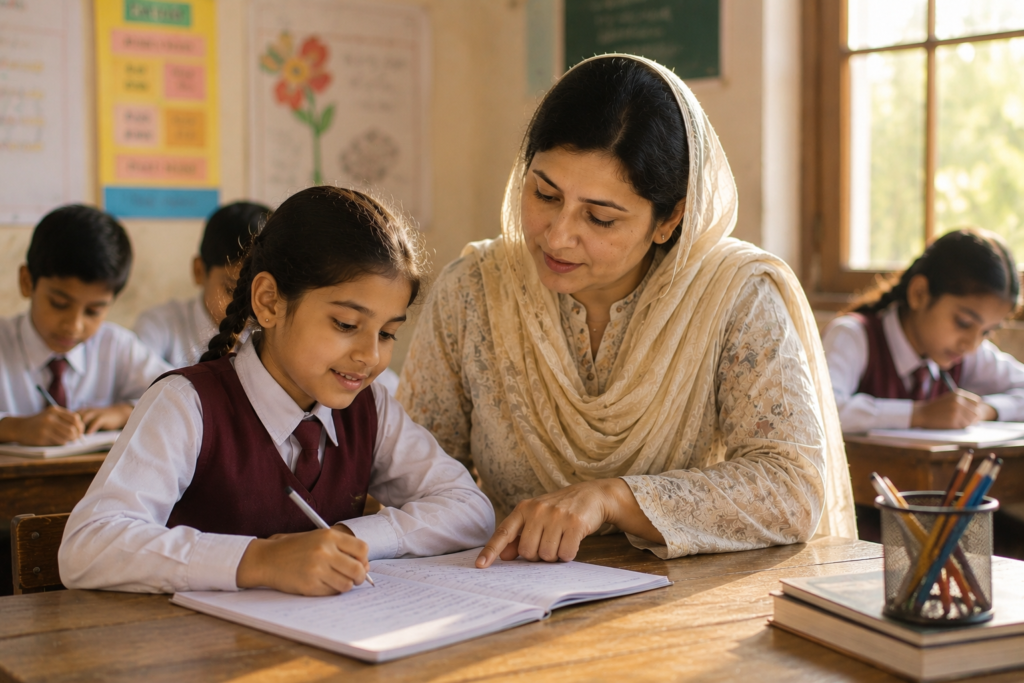
One of the parents from our current Grade 4 cohort recently shared something that stayed with us. She said:
“I love and appreciate the most that you are considering where the child stands in his learning, and the instruction is customised and differentiated.”
Parent, TWF previous cohort
That idea sits at the centre of how we think about education at The Way Forward, Pakistan’s alternative online school for ages 8 to 12.
For a very long time, schools around the world have been built around standardisation. Children enter classrooms and are expected to adjust themselves to a fixed structure: the same pace, the same method of instruction, the same style of assessment, and often the same expectation of how learning should look. But children themselves have never been uniform. They do not think identically, process information identically, or express understanding identically.
Some children understand concepts quickly when they can visualise them. Some need discussion before ideas begin making sense. Some require repetition before confidence appears. Some think very deeply but need more time to organise their responses. Others flourish when they are allowed to explore their thinking verbally before putting it onto paper.
None of these learners are less capable. They are simply engaging with learning differently. And a system that cannot see that difference will consistently mistake pace for ability and silence for understanding.
“The problem is not the child who cannot keep up. The problem is a system that moves at one speed for everyone.”
Differentiated learning for children in Pakistan is not a common reality in most schools. In a classroom of thirty or more students, a teacher working through a fixed syllabus has little room to adjust pace, method, or depth for individual learners. The child who already understands sits waiting. The child who has not yet understood falls further behind. Both lose something.
At TWF, differentiated instruction is not an additional feature layered on top of the program. It forms part of the foundation itself.
Before meaningful teaching can begin, we need to understand how a child thinks, communicates, processes information, responds to challenge, and emotionally experiences learning. That is exactly what our diagnostic process is designed to reveal. Every child who joins TWF begins with a structured assessment that maps not just what they know but how they learn. Instruction then begins from where the child actually is, not from where the syllabus assumes they should be.
Lev Vygotsky’s theory of the Zone of Proximal Development explains that children learn most effectively when they are working slightly beyond their current level but still receiving enough support to remain engaged and successful. Meaningful learning happens when challenge and guidance exist together. If learning becomes too easy, growth slows. When learning becomes overwhelming without support, many children stop engaging before understanding has the chance to develop.
Jerome Bruner expanded this further through the concept of scaffolding, where support is intentionally provided during learning and gradually reduced as competence develops. Strong teaching does not simply present information and expect immediate mastery. It carefully guides children toward understanding while recognising that confidence develops gradually, not instantly.
These are not abstract theories at TWF. They describe how instruction is actually designed and delivered every day.
Because children express understanding in different ways, assessment at TWF reflects that reality. Traditional systems often reward one specific type of learner: usually the child who can process information quickly and reproduce it under pressure in a conventional format. But genuine understanding does not always appear in one fixed way.
Some children communicate understanding beautifully through discussion. Some through reflective writing. Some through visuals and interpretation. Others need scaffolded questioning before they are ready to think independently with confidence. This is why students at TWF encounter multiple pathways for engagement: guided inquiry, visual interpretation tasks, reflective prompts, layered questioning structures, and discussion-based thinking experiences designed to surface genuine understanding rather than surface-level memorisation.
The goal is not to make learning easier. It is to make learning more accessible, more responsive, and more connected to the actual child sitting in front of the educator.
Confidence rarely develops in environments where children constantly feel compared, rushed, or left behind. It grows when children experience challenges while still feeling supported enough to continue trying, questioning, and engaging with the learning process.
Parents in Pakistan who are searching for an alternative to a one-size-fits-all school often describe the same pattern: a child who is clearly capable at home but shuts down in the classroom. A child who asks brilliant questions in conversation but goes quiet the moment a formal task begins. A child who has been labelled average or slow by a system that simply could not see how they learn.
Differentiated learning for children in Pakistan is not a luxury or a specialised intervention for struggling students. It is what good teaching looks like. Every child deserves instruction that begins from where they are, challenges them appropriately, and supports them genuinely.
“Alhamdulillah, it was a great experience watching my child gain more and more confidence with each passing day. This could not have been possible without the immense efforts Sir Idrees and the team have been showing.”
Parent, TWF previous cohort
Children do not need identical instruction. They need instruction that meets them where they are and helps them move forward from there.