We have got Limited Seats and they are filling up fast! Book Free Assessment
Now
!

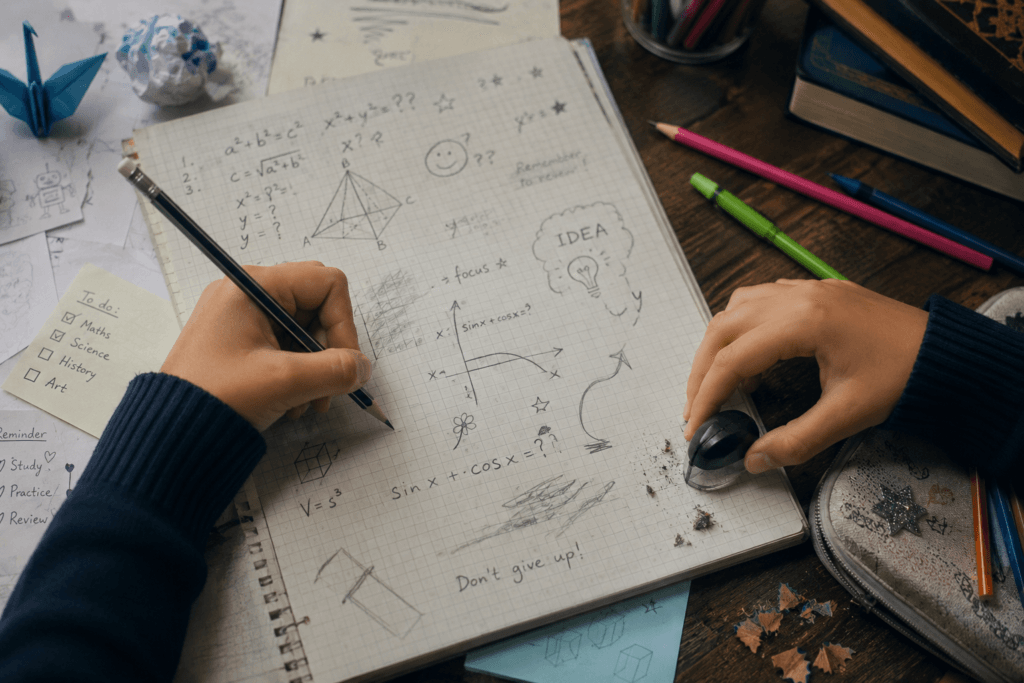
There is probably a child coming to mind as you read this. The one who cannot sit still. The one who keeps reaching for a pencil even when nobody asked them to write anything down. The one whose eyes wander around the room while everyone else seems focused. The one who picks things up, fiddles with objects nearby, shifts in their seat, or appears to be looking everywhere except where they are supposed to be looking.
Most adults would describe that child as distracted. Over the years at TWF, we have learned to be more careful with that label.
One of the unexpected advantages of conducting assessments online is that we observe children in their natural learning environments. We are not simply measuring whether they arrive at the correct answer. We are watching what happens in the space between the question and the answer. We are seeing how children respond when they encounter uncertainty, how they organise their thoughts, what resources they naturally reach for, and what behaviours emerge when they are trying to make sense of something unfamiliar.
These observations have taught us far more about child learning behaviour than any score ever could.
One moment from a recent assessment session stays with us. A child got up from his chair mid-question and moved toward the resource box. At first glance it could have looked like restlessness or avoidance. But that was not what was happening. He picked up a pencil and a coloured pencil, came back to his seat, and used both of them to work through the maths problem in front of him. He had understood what he needed, found the right tools, and used them to reach the answer. What looked like distraction was actually resourcefulness.
A pattern appears repeatedly. A child begins grappling with a problem and instinctively reaches for a piece of paper. Another starts sketching while thinking. Some pick up objects nearby and begin fiddling with them. Others look around the room, move constantly in their seats, or seem unable to remain physically still. Almost immediately, an adult intervenes. They ask the child to sit properly, focus on the screen, stop playing with things, or pay attention. The response is completely understandable, because from the outside it looks as though the child has become distracted. Yet what we observe time and time again is that many of these children are not moving away from the learning. They are moving through it.
When children reach for materials, sketch ideas, manipulate objects, or move while thinking, they are often engaging in what is described as tinkering. Their hands become part of the learning process. Their bodies help them process information. The movement is not necessarily evidence that attention has disappeared. In many cases it is evidence that attention is actively at work.
Adults do this too. We pace while making difficult decisions. We scribble notes during meetings. We draw shapes while processing ideas. Yet when children engage in the same behaviours, we often assume they have stopped paying attention. Understanding why children fidget while learning, rather than simply stopping it, is one of the most practical shifts a parent or teacher can make.
“Thinking does not always look neat from the outside. Sometimes it looks messy. Sometimes it looks restless. Sometimes it looks like a child filling an entire page with sketches while trying to solve a maths problem.”
At TWF, we use the phrase tinker time deliberately. It sits within a broader approach to active learning, where children are not passive recipients of instruction but participants in their own thinking process. We want children to recognise that this process has value. Naming it changes how everyone in the room understands what they are seeing. The child stops feeling as though they are doing something wrong. Parents begin recognising a learning behaviour rather than a behavioural problem. Educators start looking beyond appearances and paying closer attention to the thinking underneath.
Perhaps the most striking thing we have noticed is that some of the children who move around the most are also the children who are most deeply engaged. They are excited. They are curious. They are trying to hold onto an idea that feels bigger than their ability to immediately express it. They reach for resources because they are searching for ways to make their thinking visible. They sketch because their thoughts are moving faster than their words.
To someone watching casually, it may look like distraction. To someone paying close attention, it often looks like learning.
This becomes even clearer when we consider how children naturally think. A question rarely remains just a question. One idea leads to another. A connection sparks a memory. A problem triggers a new line of inquiry. Their minds begin filling gaps, making predictions, and exploring possibilities that were never explicitly stated. The child’s attention has not disappeared. It has expanded beyond the immediate task and begun connecting what they are learning to a wider network of ideas. Educational psychologists refer to this as inferential thinking: the ability to connect information, fill gaps, make predictions, and generate ideas beyond what was explicitly taught. It is a sign of genuine cognitive engagement, not absence of focus.
Many educational environments have been built around a very narrow image of what focus should look like. A focused child sits still, looks in one direction, responds quickly, and behaves quietly. Yet children are remarkably diverse in how they think. Some think through movement. Some think through discussion. Some think through sketching. Some need to physically manipulate materials before understanding begins to emerge. These are not problems to fix. They are different child learning styles, each valid, each capable of producing genuine understanding when given the right environment. The challenge is that traditional systems often reward only one version of learning while unintentionally discouraging many others.
This is a particularly relevant issue in Pakistan, where classrooms are typically large, time is limited, and teachers are managing thirty or more children at once. In that environment, the child who fidgets, sketches, or moves constantly is almost always interpreted as a discipline problem rather than a thinking child who needs a different kind of space.
At TWF, the small cohort size, the online environment, and the deliberate observation built into every session mean that a child’s learning behaviour is actually visible to the educator. We are not managing a crowd. We are watching individuals. That changes what we are able to notice, and what we are able to respond to.
The next time your child reaches for something while working through a problem, or gets up from their seat, or starts drawing on the edge of their paper, pause before telling them to stop. Ask instead: are they disengaged, or are they thinking in the way that works for them? Focus and attention in children do not always look the way we expect. Sometimes the child who appears least focused is the one working hardest.
The difference matters. A child who is told repeatedly that the way they naturally think is wrong does not become a more focused learner. They become a more self-conscious one. They start hiding their process rather than trusting it. And slowly, the curiosity and experimentation that are the foundation of genuine learning begin to disappear.
Preserving a child’s natural learning behaviour, understanding it rather than suppressing it, is one of the most important things an educator or parent can do during the middle years. At TWF, it is something we think about every single day.