We have got Limited Seats and they are filling up fast! Book Free Assessment
Now
!

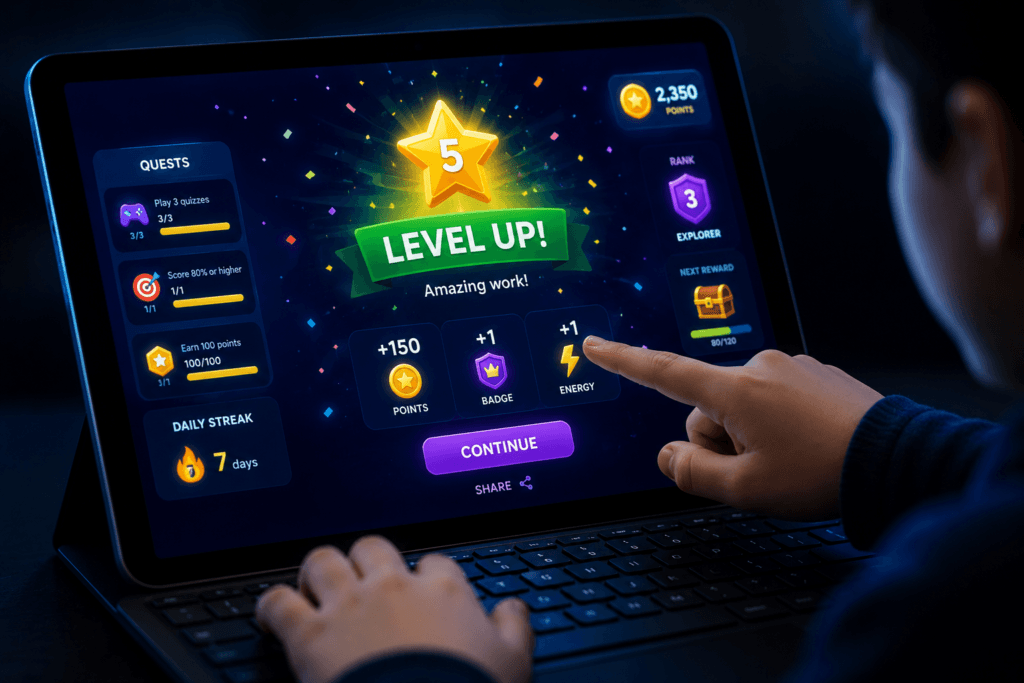
Imagine a child rejoicing while attempting an assessment. That sounds unrealistic, right? At The Way Forward, Pakistan’s alternative online school for ages 8 to 12, it is a common experience. Our approach to gamified learning for kids in Pakistan has completely redesigned what assessments feel like, and what they are able to do for a child’s confidence.
This journey begins with a specialised diagnostic evaluation taken before the child even enters TWF, giving us a holistic understanding of the child through behaviour indicators and learning patterns. From there, our assessments are designed so that every question a child attempts earns them scores and level-up points. Kids get excited over points, celebrate level-ups, and stay positive even when they get an answer wrong.
Traditional online learning treats students like viewers, not participants. In a short time, students start feeling stressed, disengaged, or overwhelmed. At TWF, gamification has changed everything. Students are not just staring at a page. They have options: doubling their score, earning points, unlocking rewards, levelling up, retrying questions, competing with themselves, and removing unnecessary options to narrow their choices down to the two most likely answers. After some time, students stop saying ‘I did my assessment.’ They start saying ‘I collected 20 points.’ That is the moment when they actually start enjoying the experience. This reduces pressure, boosts confidence, and helps children decide on the right answer with logic rather than anxiety.
At TWF, we have shifted away from rigid grading and stressful assessments toward making mistakes a natural part of progress. Because attempting a question earns points regardless of whether the answer is right, feedback becomes a source of validation rather than anxiety.
There is an interesting fact about human behaviour: when people are given the option to try again, they continue far longer than expected. In our gamified learning environment, this is the whole point. When a student gets a question wrong and sees their result, they do not feel discouraged. They think: ‘Let me fix this.’ Suddenly, learning is no longer about mistakes. It is about how you learn from them and improve.
Children in our program respond with genuine excitement. ‘Oh my God, I got so many points!’ And then on to the next question: ‘Oh my God, more points!’ Their feedback loop is immediate and positive. Even when they pick the wrong option, the system validates their attempt, awards points for trying, and gives them the option to retry. That small reward changes the emotional experience of learning entirely. Rather than thinking ‘I failed’, students think ‘Maybe I can do better next time.’ The emotional sting of failure disappears. Many kids, even when they get something wrong, say: ‘I got a lesser score, but I still got points!’ They are happy. This has transformed testing into a reward-driven process where students stop judging their own capabilities so harshly.
Parents often notice the change before they see it academically. Instead of avoiding assessments or feeling nervous about results, children begin talking about their scores, points, and progress with enthusiasm. The conversation shifts from ‘Did I pass?’ to ‘Look how much I improved.’
This works because of something called a dopamine feedback loop. Dopamine is a brain chemical connected to reward, excitement, and motivation. When students score points, answer correctly, or level up, the brain receives a feeling of achievement. When learning feels rewarding, students genuinely want to continue.
This is exactly why gamified learning works so effectively for children, and why it is particularly valuable in Pakistan, where traditional assessment culture has historically created high anxiety around academic performance.
Gamified assessments treat mistakes as part of progress rather than as something to be penalised. Instead of feeling ashamed, children experience positive reinforcement. This creates a healthy relationship between students and learning. They become more curious, participate more willingly, and want to experiment rather than fear making mistakes.
Some children are motivated by creativity, exploration, self-expression, and social interaction. Others are motivated by challenge, achievement, progress, and mastery. Most children are driven by a combination of both.
At TWF, our gamified assessment system is designed to engage multiple forms of motivation at the same time. Students earn points, level up, unlock rewards, revisit previous mistakes, and experience visible progress. This creates an environment where learning feels meaningful, achievable, and rewarding, helping children stay engaged over the long term not because they are forced to, but because they genuinely want to continue.
Our gamified learning platform also includes a redemption feature. At various points during the assessment, random dominoes appear on the screen. Students can pick a domino, which takes them to a question they answered incorrectly earlier, giving them the chance to fix it. This teaches something important beyond the academic content: second chances exist. The world does not work like marks on a paper. There are resources, people, and opportunities to make things better.
The redemption method builds a growth mindset in students. They begin to believe: ‘I can improve if I keep trying.’ That is exactly the mindset we want children to associate with learning and with assessments.
A child who is afraid of failure will always avoid challenges. But a student who is in a safe environment has no fear of failure. They become curious, eager to learn, and willing to experiment. That is the real difference. A fear-free learning environment does not remove all hurdles. It simply removes embarrassment and shame. Students learn, struggle, do their best, and make mistakes, but they are not terrified of doing so.
And maybe, after all, this is exactly how education was supposed to feel.
When children stop fearing assessment, they stop treating learning as a threat. They become more willing to experiment, make mistakes, ask questions, and grow. Assessment returns to its original purpose: helping a child learn, not judging their worth.
If your child is between 8 and 12 years old and you have been looking for an online school in Pakistan that builds confidence alongside capability, gamified learning at TWF may be exactly what they need. Our assessment approach is one part of a broader structured learning program built around the belief that children learn best when they feel safe, motivated, and genuinely engaged.
If the answer is yes to any of these, gamified learning is waiting for them at The Way Forward.